Modern approaches to civilization-building overwhelmingly prioritize external systems: political structures, economic models, technological infrastructures, and institutional efficiency. Progress is typically measured through visible outputs—growth rates, governance indicators, innovation indices—while the human being is treated as a secondary variable, expected to adapt to systems rather than serve as their originating source.
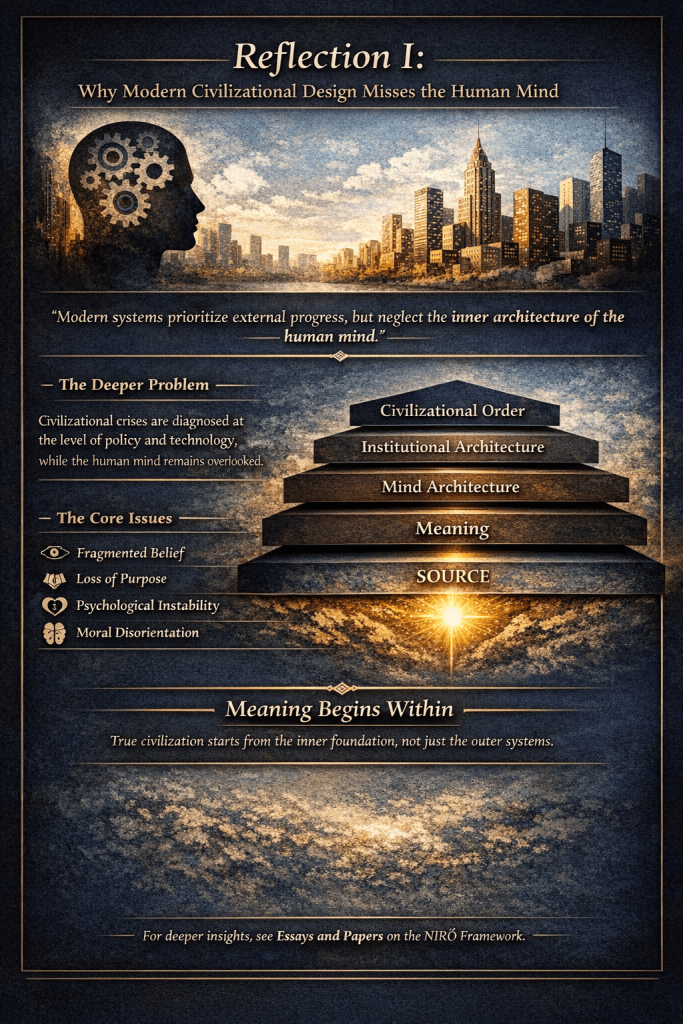
This inversion is not accidental. It reflects a deeper epistemic assumption embedded in modern thought: that civilization is fundamentally an external construct, and that human consciousness, belief, and meaning-making are derivative rather than foundational. As a result, civilizational crises are most often diagnosed at the level of policy failure, institutional weakness, or technological disruption, while the internal architecture of the human mind remains largely unexamined.
The NIRŌ framework begins from a different starting point.
Civilizations do not emerge from systems alone. They emerge from structured human meaning. Meaning, in turn, arises from the way the human mind is formed, oriented, and anchored to its source. When belief systems fragment, when purpose is displaced, and when inner coherence erodes, no amount of external optimization can sustain long-term civilizational order.
This helps explain a central paradox of the modern world: despite unprecedented technological power, contemporary civilizations increasingly exhibit symptoms of systemic instability—psychological fragmentation, moral incoherence, institutional distrust, and loss of collective direction. These are not merely social or political failures. They point to a deeper architectural failure at the level of the human mind.
From a NIRŌ perspective, civilization must be understood as a layered process:
- Source — the ultimate ground of meaning and orientation
- Meaning — the interpretive framework through which reality is understood
- Mind Architecture — the internal structure organizing belief, perception, intention, and action
- Institutional Architecture — the external embodiment of internal order
- Civilizational Order — the emergent coherence of collective human life
When this sequence is reversed—when institutions attempt to manufacture meaning, or when systems are expected to compensate for inner fragmentation—civilizational forms may persist temporarily, but they lose depth, resilience, and ethical direction.
This reflection does not aim to resolve these questions in full. Its purpose is more modest and more precise: to clarify why the human mind must be treated as a primary site of civilizational design, rather than as an afterthought. The detailed philosophical, epistemic, and structural arguments underlying this position are developed more rigorously in the Essays and Papers associated with the NIRŌ project.
Reflections such as this function as conceptual signals—markers of orientation rather than finalized academic claims. They accompany an ongoing research trajectory that seeks to reconnect source, meaning, and institutional order through a coherent architecture of the human mind.
This reflection should be read alongside the Essays and Papers sections, where the NIRŌ framework is developed in full analytical form.