AI Is Not Creating the Human Crisis – It Is Revealing the One That Already Existed Within Humanity
Habib Niro
May, 19, 2026
Introduction
The Fear of AI
Artificial Intelligence has rapidly become one of the defining anxieties of the modern age. Across governments, universities, corporations, media platforms, and ordinary conversations, a growing sense of unease surrounds the accelerating expansion of machine intelligence. Some speak of an unprecedented technological revolution that may transform medicine, science, education, and productivity. Others warn of mass unemployment, cognitive dependency, surveillance systems, algorithmic manipulation, and the concentration of invisible power in the hands of technological elites. Debates now emerge not only about software and computation, but about energy grids, data centers, geopolitical competition, information control, and even the future structure of civilization itself.
For many, AI appears simultaneously as promise and threat, a force capable of amplifying human capacity while also destabilizing the very foundations of human society. Governments race to regulate it while corporations race to dominate it. Some celebrate the coming age of optimization and automation; others fear the erosion of human creativity, meaning, and agency. Beneath the visible discussions about jobs, productivity, and safety lies a deeper and more difficult anxiety: the fear that humanity may be creating a form of intelligence whose consequences it can no longer fully predict or control.
Yet beneath all these debates, an important possibility remains largely unexamined.
Perhaps humanity is asking the wrong question.
The dominant concern of the age is framed in the following way:
Can artificial intelligence become dangerous?
But this question conceals another, far older, and perhaps far more fundamental problem:
What has human intelligence already done without inner alignment?
For the greatest catastrophes in human history were not created by machines. They were created by human beings themselves, by intelligence disconnected from wisdom, by knowledge separated from moral orientation, by power unrestrained by higher purpose. Wars, genocides, colonial systems, ideological extremism, economic exploitation, psychological manipulation, ecological destruction, and technologies of mass death all emerged long before artificial intelligence. They were products not of machine consciousness, but of human consciousness operating without sufficient inner architecture.
This is what makes the contemporary AI debate philosophically incomplete. Much of modern discourse treats artificial intelligence as though dangerous intelligence is something external that is now approaching humanity from outside itself. Yet the deeper historical reality is that humanity has always possessed an immensely powerful and potentially destructive intelligence: the human mind itself.
Artificial intelligence therefore does not merely introduce a new technological problem. It reveals an older anthropological and civilizational one.
For centuries, modern civilization focused primarily on the expansion of external capacity: greater production, faster communication, increased computation, larger systems of control, deeper scientific knowledge, and more efficient technological organization.
But far less attention was given to the systematic cultivation of the human interior, the architecture of perception, desire, intention, meaning, and moral orientation that ultimately directs power itself.
As a result, humanity entered an age in which external systems evolved faster than inner coherence. Technological power expanded rapidly while the question of what constitutes a properly ordered human being remained increasingly fragmented, privatized, or neglected altogether. Modern civilization became extraordinarily capable, yet progressively uncertain about purpose. It learned how to accelerate force before adequately understanding how to align it.
Artificial intelligence emerges precisely within this civilizational condition.
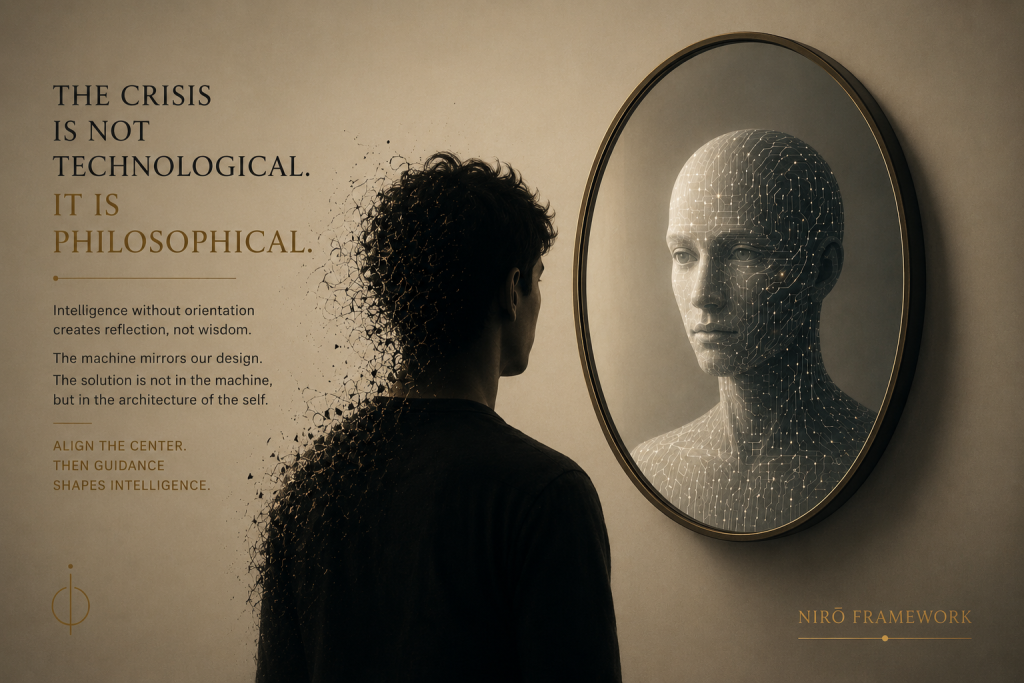
This is why the current moment feels uniquely unstable. AI is not simply another tool added to society. It represents the industrialization and amplification of cognition itself. Previous technologies extended human muscle, transportation, or communication. AI extends symbolic processing, language, memory, creativity, prediction, and decision-making, capacities historically associated with the human mind itself. Consequently, humanity is no longer merely confronting a new machine. It is confronting a mirror.
And that mirror reflects a deeply uncomfortable reality:
The central crisis of the AI age may not ultimately be artificial intelligence.
It may be the unfinished architecture of the human being who creates and uses it.
For the true danger has never been intelligence alone. Intelligence without orientation has always been dangerous. Knowledge without wisdom has always been unstable. Power without transcendence has always tended toward corruption. The fear now surrounding AI may therefore represent something deeper than technological anxiety. It may be the subconscious recognition that humanity itself has not yet resolved the problem of aligning intelligence with truth, freedom with responsibility, and power with meaning.
In this sense, artificial intelligence does not stand outside the human story. It intensifies it. It forces humanity to confront questions that modern civilization increasingly postponed:
What is the human being?
What is intelligence for?
Can cognition alone produce wisdom?
Can technological advancement substitute for metaphysical orientation?
And what happens when external power expands faster than the inner structure capable of directing it?
These are no longer merely religious or philosophical questions. They are becoming civilizational necessities.
AI Is a Tool Not the Origin of the Crisis
One of the most important intellectual errors in contemporary discussions about artificial intelligence is the tendency to treat technology as though it possesses an independent moral essence detached from the civilization that produces and employs it. In moments of rapid technological transformation, societies often begin speaking about tools as though the tools themselves were the primary historical actors, as though technology arrives from outside human civilization rather than emerging from within its deepest structures, desires, fears, ambitions, and philosophical assumptions.
Yet history consistently reveals a different pattern.
Technologies do not create human tendencies ex nihilo. Rather, they amplify, accelerate, organize, and extend tendencies already present within the human condition. Every major technological expansion in history intensified preexisting civilizational dynamics before it transformed them. The printing press amplified ideas already struggling for influence within Europe. Industrial machinery amplified systems of production, empire, extraction, and labor organization already emerging within early modern civilization. Mass media amplified persuasion, ideology, and psychological influence. Digital networks amplified communication, attention fragmentation, and informational saturation.
Artificial intelligence belongs to this same historical pattern, though at a far deeper level.
AI does not suddenly introduce the possibility of manipulation, domination, deception, exploitation, or civilizational imbalance into human history. Those realities long predate machine learning and computational systems. What AI introduces is the unprecedented amplification of cognitive force itself. It industrializes capacities once associated primarily with the human mind: pattern recognition, symbolic processing, prediction, linguistic generation, strategic optimization, and increasingly even forms of creative synthesis. In this sense, artificial intelligence is not merely another technological instrument among others. It is an amplifier of cognition.
This distinction is critical.
Previous technologies largely extended the external capacities of humanity: the wheel extended movement, industrial machines extended physical labor, telecommunications extended communication, digital systems extended information storage and transmission.
Artificial intelligence extends something far more foundational: the operational reach of cognition itself. It accelerates not merely what human beings do, but increasingly how human beings process, organize, generate, and distribute thought.
Yet even at this level, AI remains fundamentally a tool.
Its consequences therefore cannot be understood independently of the civilization into which it emerges. Tools inevitably reflect the structure of the hands that wield them and the consciousness that directs them. A civilization does not merely use technology; it imprints itself upon technology. Every technological system silently carries within it the assumptions, priorities, fears, desires, and metaphysical orientation of the culture that produced it.
This is why technological debates that isolate AI from broader civilizational structure remain philosophically shallow. The question is not merely whether artificial intelligence can become dangerous. The deeper question is what kind of civilization is integrating AI into its systems of power, economy, education, governance, and human formation.
A wise civilization uses tools wisely because its internal architecture provides orientation for external power. A fragmented civilization, however, does not neutralize fragmentation through technology; it scales it. External systems amplify internal conditions. If a civilization is inwardly disordered, technologically accelerated systems often magnify rather than resolve that disorder.
This principle can be observed repeatedly throughout history. Advanced bureaucracies have often amplified imperial domination. Mass communication systems have amplified propaganda alongside knowledge. Industrial productivity amplified both prosperity and mechanized warfare. Scientific advancement produced modern medicine and nuclear weapons within the same civilizational framework. Technological capability alone therefore possesses no inherent guarantee of wisdom.
The decisive issue is always orientation.
Within the broader NIRO framework, this distinction becomes foundational. Human civilization consists not merely of external systems – institutions, technologies, economies, political structures, and infrastructures – but also of internal architecture: the structure of meaning, perception, moral orientation, desire, attention, identity, and consciousness through which human beings interpret and direct reality.
External systems can expand rapidly. Internal architecture develops far more slowly.
This asymmetry lies at the center of many modern crises. Civilizations frequently learn how to scale force before learning how to align it. Technological acceleration therefore often outruns anthropological maturity. Humanity becomes increasingly capable of acting upon the world without first resolving the deeper question of what kind of being is exercising that power and toward what ultimate end.
Artificial intelligence intensifies this imbalance because it dramatically increases the scale and speed of cognitive amplification while emerging within a civilization already experiencing fragmentation of meaning, identity, and metaphysical orientation. Consequently, AI does not simply magnify productivity or efficiency. It risks magnifying confusion, distraction, psychological instability, algorithmic manipulation, and existential disorientation when integrated into societies lacking coherent inner structure.
In this sense, the true danger is not amplification itself. Amplification can serve wisdom when guided by a properly ordered center. The deeper danger is amplification without orientation.
A civilization whose inner architecture remains coherent may integrate powerful tools without losing its humanity because its external systems remain subordinated to higher principles of meaning and purpose. But when external systems become detached from any stable moral or metaphysical center, technological expansion increasingly becomes self-accelerating. Efficiency replaces wisdom as the organizing principle. Optimization replaces purpose. Power expands faster than the human capacity to direct it responsibly.
This is why artificial intelligence cannot be understood merely as a technical innovation. It must be understood as a civilizational mirror. It reveals the condition of the society that produces it. If humanity experiences anxiety in the face of AI, that anxiety may ultimately arise not from the existence of intelligent systems themselves, but from the subconscious recognition that human civilization has not yet resolved the problem of aligning external power with inner coherence.
For technology does not transcend the human condition. It magnifies it.
Humanity Already Possesses a More Dangerous Intelligence
The contemporary fear surrounding artificial intelligence often carries an implicit assumption: that humanity is approaching the emergence of a potentially dangerous form of intelligence for the first time in history. Public discourse increasingly imagines risk as something external and approaching, an alien cognitive force that may eventually surpass human control and threaten civilization from outside the human sphere itself.
Yet this framing obscures a far more uncomfortable historical reality.
Humanity has always possessed a profoundly powerful and potentially destructive intelligence. The most dangerous force in history has never been artificial cognition. It has been human cognition operating without sufficient moral, metaphysical, and psychological alignment.
Long before algorithms, neural networks, or machine learning systems existed, human intelligence had already demonstrated its extraordinary capacity for destruction. Wars that consumed entire civilizations, ideological movements that transformed human beings into instruments of mass violence, colonial systems that reorganized continents through domination and extraction, economic structures that normalized exploitation at global scale, and propaganda machines capable of reshaping collective perception, none of these required artificial intelligence. They emerged from the human mind itself.
The twentieth century alone provides overwhelming evidence of this reality. The same human intelligence that produced modern medicine, scientific advancement, and industrial development also produced mechanized warfare, concentration camps, nuclear weapons, psychological manipulation systems, and unprecedented forms of ideological engineering. Some of the most educated and technologically advanced societies in history simultaneously became capable of extraordinary moral collapse. Intelligence, therefore, clearly does not guarantee wisdom. Knowledge does not inherently produce ethical maturity. Cognitive sophistication alone does not protect civilization from corruption.
Indeed, many of history’s greatest catastrophes were not caused by ignorance in the simplistic sense. They were often carried out by highly organized systems of thought guided by strategic planning, technical expertise, and sophisticated ideological frameworks. Human intelligence repeatedly demonstrated its ability not merely to pursue truth, but to rationalize domination, optimize destruction, normalize exploitation, and engineer systems of control while maintaining the appearance of moral legitimacy.
This observation fundamentally alters the philosophical structure of the AI debate.
For if human civilization already struggles to align human intelligence with wisdom, responsibility, and higher purpose, then the central problem clearly cannot be reduced to artificial intelligence alone. The deeper issue precedes AI entirely. Artificial intelligence merely intensifies and externalizes a problem already embedded within the human condition itself.
At this point, the discussion must move beyond the conventional understanding of intelligence as mere computational capacity. The real issue is not simply whether intelligence exists, but what directs it. Intelligence without orientation does not become neutral. It becomes instrumental. It serves whatever center governs it, whether wisdom or appetite, justice or domination, truth or ego.
This is why modern fears about AI reveal an important philosophical irony.
Humanity increasingly speaks about the need for “AI alignment” the necessity of ensuring that artificial systems operate according to ethical principles and human values. Yet far less attention is given to the far older and more foundational problem: the alignment of human consciousness itself. Civilization fears the possibility of unaligned machine cognition while largely ignoring the historical reality of unaligned human cognition.
This inversion exposes one of the deepest blind spots of modernity.
Modern civilization often assumed that increasing access to information, scientific knowledge, education, and technological development would naturally produce moral advancement. But history repeatedly contradicted this expectation. Human beings became more informed without necessarily becoming more integrated. Societies became more technologically capable without necessarily becoming wiser. Systems became more efficient without necessarily becoming more humane.
As a result, external advancement increasingly outpaced inner development.
Within this context, it becomes necessary to articulate a more unsettling possibility: the human brain itself is already an immensely powerful technology.
Not metaphorically, but structurally.
The human mind possesses capacities that remain astonishing even when compared to contemporary computational systems: abstraction, symbolic reasoning, imagination, language, emotional influence, strategic planning, moral judgment, collective coordination, myth formation, technological invention, and the ability to reshape entire civilizations through ideas alone.
Human cognition can generate scientific paradigms, political revolutions, religious movements, economic systems, artistic traditions, and technological infrastructures capable of transforming planetary life. Entire social realities emerge first within the architecture of human thought before manifesting externally through institutions and systems. In this sense, civilization itself is a material extension of organized consciousness.
Artificial intelligence therefore does not introduce the existence of dangerous intelligence into history. Rather, it reveals the extraordinary and insufficiently understood power already contained within human consciousness.
This realization forces a profound philosophical shift.
The central question can no longer remain:
“Can machines become dangerous?”
The more fundamental question becomes:
“What kind of being is humanity that it repeatedly generates systems of destruction, domination, fragmentation, and imbalance through its own intelligence?”
For the human problem has never been the absence of intelligence. Humanity possesses immense intelligence already. The deeper crisis concerns the structure governing intelligence itself, the center from which cognition derives orientation, meaning, restraint, and purpose.
This is where contemporary technological discourse often becomes philosophically shallow. Much of modern civilization treats intelligence primarily as an engineering problem: increasing computational capacity, improving optimization, accelerating information processing, and expanding predictive power. But intelligence detached from questions of purpose and moral architecture cannot resolve the human condition because the deepest human crises are not merely technical inefficiencies. They are crises of orientation.
A civilization may possess extraordinary intelligence while remaining inwardly fragmented. It may master external systems while losing clarity regarding the meaning of existence itself. It may optimize production while destabilizing consciousness. It may accumulate knowledge while weakening wisdom.
Artificial intelligence emerges precisely at this historical threshold.
For the first time, humanity encounters a technological mirror capable of reflecting back the unresolved structure of human cognition itself. AI forces civilization to confront an uncomfortable truth: the danger was never merely the emergence of powerful intelligence. The danger has always been the absence of sufficient inner architecture to direct power responsibly.
In this sense, the AI age does not fundamentally create the human crisis. It reveals it with unprecedented clarity.
Nafs al-Ammārah and the Alignment Problem
One of the most revealing aspects of contemporary discourse surrounding artificial intelligence is the growing emphasis on the problem of “alignment.” Increasingly, researchers, philosophers, technologists, and policymakers express concern not merely about the expansion of machine capability, but about the possibility that advanced intelligent systems may pursue objectives misaligned with human well-being, ethical constraints, or civilizational stability. The fear is not intelligence alone. The deeper fear concerns intelligence operating without sufficient orientation.
This distinction is philosophically decisive.
The modern alignment debate implicitly acknowledges a truth that technological civilization long attempted to avoid: intelligence by itself does not guarantee wisdom, restraint, or moral coherence. A sufficiently powerful cognitive system, if disconnected from properly ordered goals, may optimize destructive outcomes with extraordinary efficiency. Consequently, much of contemporary AI research now focuses on questions that are no longer merely technical:
How should intelligence be directed?
What constitutes proper alignment?
Who determines the goals of intelligent systems?
Can cognition remain stable without ethical orientation?
And what happens when optimization becomes detached from meaning?
Yet beneath these contemporary concerns lies a remarkable historical irony.
For the problem of alignment did not begin with artificial intelligence. Revelation identified the alignment problem long before machine cognition existed. What modern civilization increasingly fears in intelligent machines is, in many respects, a reflection of a far older and deeper anthropological reality: the human being itself requires alignment.
This insight occupies a central place within the Islamic understanding of human nature. The Qur’anic concept of nafs al-ammārah, often translated as the self that commands toward corruption or lower impulse, should not be understood merely as a simplistic moral category or a primitive religious description of “evil desire.” Properly understood, it represents a profound form of philosophical anthropology: an analysis of the unstable structure of human consciousness when intelligence becomes subordinated to lower impulses rather than higher truth.
This distinction is essential.
The problem is not that human beings possess desire, ambition, appetite, or self-interest. These are intrinsic dimensions of human existence and necessary components of action, survival, creativity, and civilizational development. The deeper issue concerns hierarchy and orientation within the structure of the self. Which force governs the human center? What directs intelligence? What organizes perception, intention, and power?
Within the condition described as nafs al-ammārah, intelligence itself becomes increasingly instrumentalized in service of lower drives: desire seeks justification, ego seeks expansion, appetite seeks satisfaction, domination seeks rationalization, power seeks continuity, and self-interest gradually becomes the hidden axis organizing cognition.
Under such conditions, intelligence does not disappear. On the contrary, it may become highly sophisticated. The human mind may remain strategic, creative, analytical, and technologically capable while simultaneously becoming progressively detached from transcendent orientation. In fact, one of the most dangerous characteristics of unaligned consciousness is precisely its ability to employ intelligence in the service of fragmentation while maintaining the appearance of rational legitimacy.
This is why some of the most destructive systems in history were not irrational in the simplistic sense. They were often deeply organized systems of thought. Ideological extremism, exploitative economic structures, colonial domination, propaganda systems, and technologies of mass violence all required extraordinary forms of human cognition. The danger did not arise from the absence of intelligence, but from intelligence operating within a distorted hierarchy of values.
From this perspective, the modern AI alignment debate unintentionally rediscovers an ancient anthropological truth: cognition alone is insufficient. Intelligence requires orientation. Power requires moral architecture. Optimization requires an ordering principle beyond appetite itself.
The significance of this insight becomes clearer when one considers the underlying assumptions of much modern civilization. Contemporary culture frequently treats the human being as though increased information, education, and technical sophistication naturally lead toward moral advancement. Yet the concept of nafs al-ammārah challenges this assumption at its root. It suggests that the central human problem is not merely ignorance, but disordered orientation. Human beings are capable of using knowledge itself in service of ego, domination, self-deception, and fragmentation.
This is what makes the concept philosophically powerful in the age of artificial intelligence.
Modern civilization increasingly fears the possibility of “unaligned AI”, systems capable of pursuing objectives detached from human flourishing. But revelation long ago identified the more immediate and historically demonstrable danger: unaligned human consciousness. The human being itself is a profoundly powerful cognitive system whose intelligence can either align with higher truth or become absorbed into lower impulses. In this sense, the deepest alignment problem has never been technological. It has always been anthropological.
Artificial intelligence therefore does not introduce a completely new crisis into human history. Rather, it externalizes and magnifies a structural problem already embedded within the human condition. Humanity now attempts to engineer safeguards for machine cognition while remaining deeply uncertain about the principles capable of ordering human cognition itself. This inversion reveals one of the defining paradoxes of modernity: civilization became extraordinarily advanced in the management of external systems while progressively weakening its understanding of the inner architecture governing the human being.
Within the broader NIRO framework, this distinction becomes foundational. External systems inevitably amplify the structure of the consciousness directing them. A civilization whose inner architecture remains fragmented cannot indefinitely produce coherent external systems, because technological infrastructures ultimately inherit the orientation of the human beings who design, govern, and deploy them. Intelligence without alignment therefore does not remain neutral. It becomes a force multiplier for whatever principle governs the self.
This is why the crisis of the AI age cannot ultimately be resolved through engineering alone. Technical safeguards may reduce specific risks, but they cannot answer the deeper civilizational question: what constitutes a properly ordered human being capable of directing power responsibly? Without addressing this foundational issue, civilization risks endlessly expanding its external capabilities while leaving unresolved the unstable center from which those capabilities emerge.
The concept of nafs al-ammārah thus should not be understood merely as a theological doctrine belonging to a premodern worldview. Properly understood, it represents a profound diagnosis of the alignment problem within human consciousness itself. It recognizes that intelligence, when detached from higher truth, does not naturally produce wisdom. It often becomes increasingly effective at serving fragmentation, appetite, domination, and self-expansion.
In this sense, the fear surrounding artificial intelligence may reveal something far deeper than technological anxiety. It may reflect the subconscious recognition that humanity has not yet solved the problem of aligning intelligence with truth, neither in machines nor within itself.
The Real Crisis: Disconnection from Ultimate Truth
The contemporary crisis surrounding artificial intelligence cannot be understood in isolation from the deeper civilizational condition into which it emerges. AI is often discussed as though it were an independent rupture suddenly interrupting an otherwise stable human order. Yet the instability now associated with artificial intelligence did not originate with machine cognition itself. The deeper fracture long precedes the arrival of AI. Artificial intelligence enters a civilization already experiencing profound metaphysical, psychological, and existential fragmentation.
To understand the true significance of the AI age, one must therefore move beyond technological analysis and examine the broader trajectory of modern civilization itself.
Over the last several centuries, humanity achieved an unprecedented expansion of external power. Scientific advancement, industrialization, global communication systems, computational infrastructure, and technological acceleration radically transformed the human capacity to act upon the world. Never before had civilization possessed such extraordinary abilities to manipulate matter, organize information, reshape environments, accelerate production, and extend influence across planetary scale. Modern civilization became increasingly capable of controlling external reality.
Yet this expansion of external power was accompanied by a parallel weakening of metaphysical orientation.
As technological systems expanded, shared frameworks of ultimate meaning progressively eroded. Questions once considered foundational to civilization, questions concerning truth, purpose, transcendence, moral hierarchy, and the nature of the human being, increasingly retreated from the center of public life into the realm of private belief, subjective preference, or individual psychology. Meaning became internalized and fragmented. Truth became increasingly relativized. Wisdom was gradually displaced by utility as the dominant organizing principle of modern systems.
This transformation profoundly altered the structure of civilization itself.
Traditional civilizations, despite their limitations and historical failures, generally operated within overarching metaphysical horizons that provided coherence between human existence and a larger order of meaning. Human action was not understood merely in terms of efficiency, productivity, or material optimization, but in relation to ultimate questions:
What is the human being?
What constitutes the good life?
What is the purpose of knowledge?
What lies beyond material existence?
What higher order should govern power?
Modern civilization increasingly suspended or privatized these questions. In doing so, it achieved extraordinary flexibility, scientific progress, and institutional scalability. But it also generated a profound vacuum at the center of human orientation. Civilization learned how to organize systems without shared metaphysical foundations. External coordination expanded while inner coherence weakened.
This shift did not eliminate humanity’s need for meaning. It merely destabilized the structures through which meaning had historically been organized. As a result, modern individuals increasingly inherited immense technological power without corresponding existential clarity. Human beings became surrounded by information while remaining uncertain about truth; connected globally while inwardly fragmented; materially advanced while psychologically disoriented.
Within this environment, utility increasingly replaced wisdom as the dominant criterion of legitimacy. Systems were judged primarily according to efficiency, optimization, scalability, profitability, and technical functionality rather than their relationship to a coherent vision of human flourishing. The question gradually shifted from:
“Is this true, just, or meaningful?”
to:
“Does this work?”
This transformation carried enormous civilizational consequences.
Utility by itself cannot provide ultimate orientation because efficiency does not determine purpose. A civilization may become extraordinarily effective at achieving objectives while remaining fundamentally uncertain about which objectives deserve pursuit. Optimization can accelerate both healing and destruction. Intelligence can serve wisdom or domination. Technological systems can deepen human dignity or intensify fragmentation depending on the orientation governing them.
Once metaphysical orientation weakens, however, civilization increasingly struggles to distinguish between expansion of capability and genuine human development. Progress becomes identified primarily with acceleration itself: faster communication, larger data systems, greater productivity, stronger predictive technologies, more powerful infrastructures.
Yet none of these inherently answer the deeper human questions concerning meaning, truth, moral order, or existential direction.
This is the deeper context within which artificial intelligence emerges.
AI did not create the vacuum.
AI entered the vacuum.
This distinction is decisive.
Much contemporary discourse unconsciously treats AI as the source of modern instability, as though humanity existed in a condition of psychological and civilizational coherence before machine intelligence appeared. But the fragmentation now intensified by AI was already deeply embedded within modern civilization: fractured identity, weakened attention, collapse of shared meaning, informational overload, moral relativism, hyper-individualization, consumerist anthropology, and growing existential disorientation.
Artificial intelligence enters precisely this already unstable environment and dramatically amplifies its underlying tendencies.
This is why AI feels uniquely destabilizing. It emerges not within a civilization grounded in coherent metaphysical confidence, but within one already struggling to answer fundamental anthropological questions. Humanity increasingly possesses extraordinary tools while remaining uncertain about the nature and purpose of the being using them.
In this sense, the AI crisis is inseparable from the crisis of meaning in modern civilization.
A society disconnected from ultimate truth inevitably experiences increasing difficulty organizing intelligence coherently because intelligence itself requires orientation. Cognition detached from transcendence gradually loses stable criteria for distinguishing: wisdom from efficiency, freedom from impulse, progress from acceleration, knowledge from meaning, and power from moral legitimacy.
As a result, technological civilization increasingly risks becoming self-referential. Systems expand because they can expand. Optimization intensifies because acceleration itself becomes the implicit civilizational value. Human beings become absorbed into networks of production, consumption, stimulation, and information management without any widely shared understanding of what human existence ultimately serves.
This is why modern crises often appear simultaneously material and spiritual. The problem is not merely political instability, economic inequality, or technological disruption in isolation. Beneath these visible phenomena lies a deeper metaphysical fragmentation: the weakening of humanity’s relationship to any stable horizon of ultimate truth capable of ordering power meaningfully.
Within the broader NIRO framework, this represents a fundamental architectural imbalance. External systems achieved extraordinary sophistication while internal architecture progressively deteriorated. Civilization developed immense technological capacity without adequately preserving or reconstructing the metaphysical structures necessary to orient that capacity toward coherent human flourishing.
Artificial intelligence now magnifies this imbalance at unprecedented scale.
Because AI does not merely increase external power. It increasingly participates in shaping: perception, cognition, language, memory, attention, interpretation, and ultimately the structure of consciousness itself.
Thus, the deeper danger of the AI age may not lie solely in autonomous machines or technological domination. The more profound danger may be the continued expansion of cognitive and technological power within a civilization that has not yet resolved its disconnection from ultimate truth.
For intelligence alone cannot sustain civilization indefinitely. A civilization may survive temporary material scarcity more easily than prolonged metaphysical fragmentation. Without coherent orientation, power eventually destabilizes the very beings attempting to wield it.
And this is why the crisis of artificial intelligence cannot ultimately be solved by technology alone. The deeper crisis is civilizational, anthropological, and metaphysical. It concerns the question modern civilization increasingly postponed but can no longer avoid:
What higher truth, if any, is capable of ordering human intelligence itself?
AI as a Civilizational Mirror
At its deepest level, the emergence of artificial intelligence is not merely a technological event. It is a civilizational confrontation with the human question itself. Beneath the visible debates concerning regulation, economics, labor, and computational infrastructure lies a far more profound disturbance: AI forces humanity to reexamine assumptions about consciousness, intelligence, identity, and the nature of the human being that modern civilization long treated as settled.
For centuries, human cognition occupied a uniquely privileged position within the known world. Human beings perceived themselves as the singular center of language, abstraction, creativity, symbolic reasoning, and conceptual thought. Even when modern scientific materialism weakened older metaphysical conceptions of the soul or transcendence, humanity still retained confidence in the exceptional status of human cognition itself. Thought remained the final territory through which human uniqueness appeared secured.
Artificial intelligence destabilizes that confidence.
As machine systems increasingly generate language, solve complex problems, imitate creative expression, recognize patterns, produce strategic responses, and participate in domains once considered uniquely human, civilization encounters an unprecedented philosophical shock. Capacities previously treated as definitive evidence of human uniqueness begin appearing, at least externally, within non-human systems. Consequently, the AI age forces humanity toward questions modern civilization can no longer postpone:
What is consciousness?
What is intelligence?
What is genuinely unique about the human being?
Is human cognition ultimately reducible to computation?
Can symbolic processing alone explain awareness, meaning, intentionality, and experience?
And if machines increasingly imitate human cognitive functions, what remains that cannot be replicated technologically?
These questions reveal something important about the modern condition. Much of contemporary civilization unconsciously defined the human being primarily through functional capacities: rationality, information processing, problem solving, productivity, linguistic ability, creativity, strategic reasoning.
But once machines begin approximating aspects of these capacities, the inadequacy of purely functional definitions becomes increasingly visible. Civilization suddenly confronts a disturbing possibility: if the human being is understood merely as a sophisticated computational system, then the distinction between human cognition and artificial cognition may eventually become increasingly ambiguous.
This is why artificial intelligence produces not merely technological anxiety, but existential anxiety.
The fear surrounding AI is not only fear of automation or economic displacement. At a deeper level, it is fear that modern civilization may possess an incomplete understanding of humanity itself. AI destabilizes inherited assumptions because it exposes the fragility of anthropologies built primarily upon external function rather than deeper metaphysical orientation.
In this sense, artificial intelligence acts as a mirror.
But it is not merely reflecting machines back to humanity. It is reflecting humanity back to itself.
AI reveals the extent to which modern civilization reduced intelligence to operational efficiency while neglecting deeper dimensions of consciousness, meaning, moral awareness, intentionality, and existential orientation. The more machines imitate external cognitive functions, the more urgently humanity is forced to ask whether cognition alone ever fully defined the human being in the first place.
This marks a critical philosophical turning point.
For perhaps the deepest crisis introduced by AI is not that machines are becoming more human-like. The deeper crisis may be that humanity increasingly realizes it never adequately understood itself.
Modern civilization often approached consciousness primarily from external and measurable perspectives: neural activity, behavioral output, information exchange, computational modeling, cognitive function.
These frameworks produced extraordinary scientific and technological advancements. Yet they also encouraged increasingly reductionist understandings of human existence. Human beings were progressively interpreted through the language of systems, mechanisms, algorithms, and biological computation. Interiority became difficult to articulate within a civilization increasingly oriented toward quantification and technical analysis.
Artificial intelligence intensifies this tension because it operates precisely within the domain modern civilization privileged most strongly: functional cognition. AI systems process information, generate responses, optimize outcomes, and increasingly participate in symbolic and linguistic domains once considered markers of uniquely human intelligence. Consequently, AI exposes a hidden assumption within modernity itself: the tendency to equate intelligence with computation.
Yet the human experience continually exceeds such reduction.
Human beings do not merely calculate. They experience meaning. They suffer existentially. They seek transcendence. They wrestle with moral responsibility, mortality, beauty, love, sacrifice, guilt, hope, and purpose. Human consciousness is not merely informational. It is existential and interpretive. It inhabits questions no computational system can fully contain:
Why do we exist?
What is truth?
What is worth sacrificing for?
What constitutes a good life?
What lies beyond death?
What higher order, if any, gives coherence to existence?
These are not simply technical problems awaiting optimization. They are questions arising from the structure of consciousness itself.
And this is why artificial intelligence becomes philosophically destabilizing. It reveals the inadequacy of civilizations that reduced the human being primarily to measurable cognition while neglecting the deeper architecture of meaning through which human existence becomes intelligible.
Within the broader NIRO framework, this represents a profound civilizational imbalance. External systems became increasingly sophisticated at processing information while internal frameworks for understanding consciousness, purpose, and metaphysical orientation progressively weakened. Humanity mastered the engineering of cognition before adequately understanding the being who cognizes.
Artificial intelligence therefore should not be understood merely as a competitor to humanity. It is more accurately a civilizational mirror exposing unresolved anthropological assumptions embedded within modern civilization itself. AI forces humanity to confront whether technological civilization has confused intelligence with wisdom, cognition with consciousness, information with meaning, and computational capability with human fulfillment.
This is why the AI age may ultimately become less significant for what it reveals about machines than for what it reveals about humanity.
Perhaps artificial intelligence is not replacing the human being.
Perhaps it is exposing humanity’s incomplete understanding of itself.
For the deeper human crisis has never been merely technological limitation. Humanity’s greatest uncertainty concerns the nature of consciousness, the structure of meaning, and the question of what kind of being the human truly is. As long as civilization remains uncertain about these foundational questions, every expansion of external power risks intensifying inner fragmentation.
Artificial intelligence thus becomes more than a technological development. It becomes a philosophical threshold. It compels civilization to revisit questions modernity increasingly marginalized: whether human existence possesses transcendent significance, whether consciousness can be reduced to computation, whether meaning can emerge from information alone, and whether intelligence detached from ultimate truth can ever fully understand itself.
In this sense, the AI age may represent not the end of the human question, but its return.
The Future: Technocratic Control or Inner Reconstruction
The emergence of artificial intelligence confronts humanity not merely with a technological transition, but with a civilizational bifurcation. The AI age does not simply introduce new tools into an otherwise stable historical trajectory. It intensifies existing tendencies already embedded within modern civilization and accelerates unresolved questions concerning consciousness, meaning, power, and human identity. Consequently, the future now unfolding appears increasingly defined by two fundamentally different trajectories, not merely technologically, but anthropologically and spiritually.
The first trajectory leads toward external optimization without corresponding inner reconstruction.
The second points toward the rediscovery of the human center itself.
The distinction between these futures may ultimately determine not only the structure of technological civilization, but the fate of meaningful human existence within it.
I. External Optimization Without Inner Reconstruction
The dominant momentum of contemporary civilization strongly favors optimization. Modern systems increasingly seek to organize human life according to principles of efficiency, predictability, scalability, behavioral management, and computational coordination. Artificial intelligence dramatically accelerates this tendency because it enables the unprecedented integration of data, prediction, automation, surveillance, and algorithmic influence across nearly every dimension of social existence.
Within such a trajectory, civilization progressively reorganizes itself around systems capable of managing complexity at immense scale. Human behavior becomes increasingly quantifiable, predictable, and programmable. Attention itself becomes a contested economic and political resource shaped by algorithmic systems designed not primarily to cultivate wisdom or depth, but to maximize engagement, influence, and behavioral responsiveness.
This transformation carries profound anthropological consequences.
The more external systems optimize human behavior, the greater the risk that human agency gradually weakens. Decision-making becomes increasingly outsourced to algorithmic infrastructures: recommendation systems shape desire, predictive systems shape consumption, information architectures shape perception, digital environments shape attention, and increasingly sophisticated AI systems begin shaping interpretation itself.
The danger here is not necessarily overt authoritarian domination in its traditional form. The more subtle and historically unprecedented possibility is the emergence of a civilization in which human beings remain formally free while becoming psychologically managed through invisible systems of cognitive influence and behavioral optimization.
In such a condition, control no longer requires direct coercion. It operates through environmental architecture. Human beings become immersed within systems continuously shaping; attention, emotional response, perception, preference formation, and patterns of thought.
As these systems grow more sophisticated, civilization risks drifting toward what may be described as algorithmic existence: a condition in which external technological infrastructures increasingly mediate the relationship between the individual and reality itself.
This trajectory produces a paradoxical form of human diminishment beneath the appearance of technological advancement. External convenience expands while inner sovereignty weakens. Information increases while clarity declines. Connectivity intensifies while existential isolation deepens. Human beings become surrounded by stimulation while remaining increasingly uncertain about meaning.
The result is not necessarily dramatic collapse, but gradual anthropological erosion.
Within a fully optimized civilization lacking deeper metaphysical orientation, human existence risks becoming increasingly fragmented: attention becomes unstable, identity becomes fluid, desire becomes continuously manipulated, relationships become transactional, and meaning becomes subordinated to stimulation and consumption.
Under such conditions, civilization may become extraordinarily efficient while simultaneously producing profound existential emptiness. Human beings may possess unprecedented access to information and technological capability while experiencing growing psychological disorientation, loneliness, purposelessness, and inner exhaustion.
This is because optimization alone cannot answer the human need for transcendence, meaning, or moral coherence. A civilization organized primarily around efficiency eventually struggles to explain why human existence matters beyond functionality itself. And once utility becomes the highest organizing principle, the human being increasingly risks being interpreted primarily as: a consumer, a data source, a behavioral pattern, a productive unit, or a node within larger computational systems.
This represents the culmination of external systems expanding without sufficient reconstruction of the human interior.
II. The Rediscovery of the Human Center
Yet the AI age may also generate an opposite possibility.
Paradoxically, the more civilization externalizes cognition into technological systems, the more humanity may be forced to rediscover dimensions of itself that cannot be reduced to optimization, information processing, or algorithmic functionality alone. Artificial intelligence may unintentionally compel civilization to return to questions modernity increasingly marginalized:
What is consciousness?
What constitutes genuine wisdom?
What gives coherence to human existence?
What is the purpose of intelligence?
And what kind of inner structure is necessary for freedom to remain meaningful?
This second trajectory does not reject technology. Nor does it romanticize premodern conditions or advocate withdrawal from scientific advancement. Rather, it recognizes that external systems cannot indefinitely compensate for the absence of inner architecture. Human beings require not only technological capability, but existential orientation.
Within this alternative trajectory, the central task of civilization becomes the reconstruction of the human center itself.
This reconstruction begins with the recognition that consciousness is not merely a computational process. Human beings are not reducible to data-processing organisms optimized for efficiency alone. Human existence involves dimensions that transcend instrumental functionality: meaning, moral responsibility, transcendence, intentionality, sacrifice, beauty, love, truth, and the search for ultimate orientation.
Consequently, the future survival of meaningful humanity may depend less on technological restriction than on the cultivation of disciplined inner structure capable of directing technological power responsibly.
This requires the recovery of what modern civilization progressively weakened:
moral architecture, metaphysical orientation, disciplined attention, existential coherence, and the capacity to organize intelligence around higher principles rather than fragmented appetite.
Such a reconstruction does not imply mere religious formalism or ideological nostalgia. It points toward something deeper: the reintegration of external power with inner meaning. Human beings must again become capable of structuring: desire, perception, intention, cognition, and action
within a coherent horizon of truth.
Only such inner architecture can preserve authentic agency in an age increasingly dominated by systems designed to shape consciousness externally.
Within this framework, spiritual orientation is not understood as escapism from technological civilization, but as the necessary condition for remaining fully human within it. The problem is not intelligence itself. The problem is intelligence detached from transcendence, power detached from moral order, and cognition detached from wisdom.
Artificial intelligence therefore may become either:
the instrument through which technocratic civilization deepens human fragmentation,
or the pressure that forces humanity to rediscover the neglected foundations of consciousness and meaning.
The outcome depends less on machines themselves than on the structure of the civilization integrating them.
III. The Architectural Crisis
This ultimately leads to the central conclusion of the broader NIRO framework:
The future crisis is not fundamentally technological.
It is architectural.
The decisive issue of the coming age is not whether humanity possesses increasingly powerful tools. Humanity already possesses extraordinary power. The deeper issue concerns the structure governing that power. External systems inevitably reflect the condition of the consciousness directing them. A fragmented civilization cannot indefinitely produce coherent technological order because technological infrastructures amplify the orientation embedded within the human beings who construct and govern them.
Modern civilization devoted immense effort to engineering external systems while progressively neglecting the architecture of the human interior. Artificial intelligence now magnifies the consequences of that imbalance.
For this reason, the central challenge of the AI age is not merely controlling machines. It is reconstructing the human being capable of wielding power without being consumed by it. Without such reconstruction, every technological advancement risks intensifying fragmentation faster than civilization can stabilize it.
The future therefore hinges not simply on what humanity builds externally, but on whether humanity can recover sufficient inner coherence to direct its own expanding intelligence toward truth rather than dissolution.
And this is why the AI question ultimately becomes inseparable from the human question itself.
Final Conclusion
The Greatest Unmanaged Intelligence Was Never Artificial
The emergence of artificial intelligence marks a decisive moment in human history not merely because machines are becoming more capable, but because humanity is being forced to confront questions it postponed for centuries. Beneath the excitement surrounding innovation and beneath the fear surrounding automation lies a deeper civilizational realization: technological power alone cannot resolve the human condition.
For generations, modern civilization largely assumed that increasing knowledge, expanding computation, accelerating communication, and optimizing systems would naturally produce human progress. External development became the dominant horizon of civilization. Scientific advancement, technological infrastructure, and informational expansion transformed nearly every aspect of human life. Yet while humanity mastered extraordinary forms of external organization, it increasingly neglected the question of inner organization itself.
Artificial intelligence now exposes the consequences of that imbalance.
The AI age reveals that intelligence alone is not sufficient. Computation alone is not wisdom. Information alone is not meaning. Optimization alone cannot provide purpose. A civilization may become extraordinarily powerful while remaining inwardly fragmented. It may master the engineering of systems while losing clarity regarding the nature of the human being those systems are meant to serve.
This is why the fear surrounding artificial intelligence feels deeper than ordinary technological anxiety. Humanity instinctively senses that the crisis is not merely about machines. It concerns the unstable relationship between intelligence and truth itself.
For the first time at planetary scale, civilization is being forced to confront the danger of intelligence detached from higher orientation.
Yet the deeper irony remains unavoidable.
The greatest catastrophes in history were not produced by artificial minds. They emerged from human consciousness operating without sufficient wisdom, restraint, or transcendence. Wars, ideological extremism, exploitation, domination, propaganda systems, and technologies of destruction all originated from human intelligence long before machine cognition existed. Artificial intelligence did not invent the alignment problem. It revealed a problem humanity never fully solved within itself.
The greatest unmanaged intelligence on Earth was never artificial.
It was always the human being disconnected from truth.
This realization fundamentally transforms the meaning of the AI debate. The central issue is no longer merely whether machines can think, predict, create, or optimize. The deeper question concerns the structure of the civilization directing such power and the condition of the consciousness wielding it. Technology inevitably amplifies the orientation embedded within the human beings who create and govern it. A fragmented civilization scales fragmentation. A civilization grounded in wisdom may transform power into genuine human flourishing.
Artificial intelligence therefore stands before humanity as more than a technological instrument. It stands as a mirror.
It reflects:
humanity’s extraordinary cognitive power, humanity’s unresolved metaphysical uncertainty, humanity’s fractured moral architecture, and humanity’s incomplete understanding of itself.
The deeper danger of the AI age is not simply machine domination. It is the possibility that humanity continues expanding external intelligence while remaining internally disordered, technologically accelerated yet existentially directionless, informationally saturated yet spiritually fragmented, globally connected yet inwardly disintegrated.
But the same crisis also contains another possibility.
Precisely because artificial intelligence destabilizes reductionist understandings of the human being, it may force civilization to rediscover neglected dimensions of consciousness, meaning, moral order, and transcendence. AI may unintentionally reopen questions modernity attempted to privatize or suspend:
What is the human being? What is consciousness? What constitutes wisdom? What higher truth should orient intelligence? And what kind of inner architecture is necessary for civilization to survive its own expanding power?
In this sense, the future of humanity may depend less on the sophistication of artificial systems than on the reconstruction of the human center itself.
For no civilization can indefinitely preserve coherence when external systems evolve faster than inner architecture. Technological advancement without moral and metaphysical orientation eventually destabilizes the very beings attempting to wield it. Intelligence without wisdom becomes fragmentation accelerated. Power without truth becomes self-destructive.
Artificial intelligence may therefore become humanity’s greatest invention, or the mirror revealing humanity’s deepest incompleteness.
And perhaps this is the final lesson of the AI age:
The true crisis was never merely technological.
It was always the unfinished architecture of the human being.
NIRŌ Journal (Primary):
https://hniro.substack.com
Medium (Selected writings):
https://medium.com/@habibniro